Monday, April 30, 2018

Engaging the Public With Science

        Getting involved in the community is a very rewarding experience that everyone should participate in every once in a while. Throughout the semester, we participated in many different service learning activities. As a class, we made games and other activities for the Archie Carnival. It was really nice to interact with the kids playing the game and to see that they enjoyed playing it. 

Archie: Myth Or Fact?

        We watched a movie about global warming in climate change and how it was affecting different countries around the world. It was an eye opener to me as I had no clue just how much damage was being done just by climate change. Many natural disasters have caused many people to be relocated from their homes that they have known all their lives. It is devastating to those who have been affected by these disasters. Another activity that the class was involved in was helping set up the Earth Display in the Watauga Public Library. It was cool to see the library as I had no idea there was one or where it was. 

Our Class at the Watauga Public Library

        For my own service learning hours, I helped get things set up for a high school class that were coming to visit and learn about more about geology. I also helped paint fossils which was really cool. It was fun to get creative and to interpret what you think the fossil would look like. I enjoyed getting involved and helping out. In the future, I would like to get more involved in other service learning activities. I enjoy working with kids so getting involved in more things like that would be fun. 

        Scientists and science enthusiasts can educate their community about the nature of science by a variety of ways. They can host informational sessions throughout their community and post flyers or ads online broadcasting the time or place the session will be at. Also, being more active through the media could gain more attention to the cause. More people use online resources to access their information in modern society, so posting things this way could be helpful in spreading the word. It is important for correct information about science to be easily accessible and available for those who may not understand it or know much about science. 

Monday, April 23, 2018

Helping People Understand Science

    It is really important for people to understand science in today's world. Science isn't something that is going away or can be brushed off. It is in everything and anything you do in daily life. Without many scientific innovations, we would not have a lot of the things we have today. Most people don't realize that you do use science everyday even when you are not a scientist. It took science to create telephones, electricity, etc. Besides using science in your daily life, it is also important to understand where we came from and how the world works. Having knowledge of how plants survive and what ecosystems are is important for everyone to know. Educating others about science is definitely important.  

    Science can be easily explained to different audiences by a variety of ways. YouTube videos that explain certain scientific topics in a fun way can be very engaging for a younger or older audience. The video linked below is the well known Bill Nye explaining evolution with emojis. Using emojis appeals to a younger audience and they get more information about evolution in a fun way. Taking a trip to a museum with friends and getting to look at the different things there would be a cool thing to do. You get to spend time with your friends and learn some new things about history and science without having to sit in a classroom and listen. You can get involved and walk around the exhibits. 
Bill Nye Video 

    Our game was called Archie: Myth or Fact? It was a card game where you had to guess whether the statement on the card was a myth or a fact. The more you got right, the more cards you kept. Whoever had the most cards in the end, won the game.The objective of the game was to help others gain information about Archie in a fun way. The only thing that I would improve on the game would be to lower the difficulty of some of the cards, but all in all it worked out really well. The kids that played the game responded really well to it and seemed to enjoy it when they played it. 

Monday, March 19, 2018

Engaging Scientists in Public Discource


William Armstrong is an Earth Scientist who studies glaciology and a new member to the App State team when he joined back in the fall of 2017. The picture above is one that we took in his office when we interviewed him. He received his B.S. in Environmental Geoscience from Boston College. He continued his education by going to the University of Colorado at Boulder to get his Ph.D. in Geological Sciences.
So before going into this interview we first read one of Dr. Armstrong’s publications, “Spatial Patterns of Summer Geological Sciences Speed up on South Central Alaska Glaciers,” and we went in with general questions on the article and on himself. We first asked how he would describe his own article to someone without a science background. His answer was very interesting, instead of spitting out more confusion, he really reached to explain it to us as a true educator. He began by explaining that glaciers move in two different ways, the first is by flowing with a thick fluid and the second is by sliding and or slipping on top of the bed rock. This process is called Basal Sliding, this is what he was observing for the article. Even though both process is affected by climate change Basal sliding occurs faster and provides a quicker way for how glaciers respond to climate change. Dr. Armstrong also explained how he got his data through satellite imagery. By taking an overhead picture of the glacier and then repeating that overtime, they can see a change in the movement and how much the glacier has shifted. This research provides a look into the pattern of Basal Sliding across different glaciers and how they behave as a whole. This also allows for a better prediction of how glaciers will change and erode surrounding landscapes over time.
When asked what was it that made him interested in spatial patterns of glaciers Dr. Armstrong responded more with an explanation of what he studies and why. He studies change on a human time scale, he has been more interested in things we can see and observe on the earth’s surface. This is change occurring fast enough to affect people and be affected by people. This is important because the study of glaciers is relevant to us now. He was then asked why he thought this information is important and what groups of people was he trying to reach. He then responds with “You don’t want to be doing science in a vacuum, you want to be doing science that contributes to our knowledge of how the world works.” The study was then conducted because they had little knowledge on what Basal sliding might look like and it allows them to predict how glaciers will change through simulated glaciers capturing reality and figuring out how they carve through land.
When asked what the hardest part of the research was Dr. Armstrong gave two examples, the first was figuring out what he needed to extract data from the abundance of information so he could put it together in a unified story. The plots depicted in his article comes from about thirty images for each of the sixty-five glaciers. It was not as clean as it is now, it started with scattered data that he then had to turn in to a coherent plot. Bringing us to the second hardest part, treating it like a puzzle and figuring out what order things needed to go in and removing the bad data to leave behind the data that could tell something.
We then dived a little deeper into him and what has gotten him to where he is today. We began by asking if he had any other intentions of becoming something other than an earth scientist. He said of course as any little kid would but his dream was to become a “mow mow man” (a landscaper). As he got older he knew he was interested in science and started off as a biology major and later switched to geology in the attempts to avoid math and physics. He later discovered there is arguably more math and physics involved but liked it and pursued a Geology degree. Even after figuring out what degree path he wanted to take he still did not have a plan on what to do next for a career and considered going into an industry for satellite data, environmental consulting, and many more.
We then asked who his inspiration was or favorite scientist. Instead of giving us a cliché answer he responded with something a little more thoughtful and explained why his academic advisor Bob Anderson and a graduate program chair, Gwenn Flowers are his favorite scientist. Both advisors have two different approaches, however, he highly respects both and looks up to their approaches on being a mentor. Dr. Armstrong also explained to us the adaptability an academic scientist must have to find a job and why it can be so hard for someone to find a job. They must find a university, that has that particular department and a spot available for someone that fits their criteria. Someone who wants to be an academic scientist must be willing to adapt and have decided what they want for example willing to live anywhere in the world and chase the job. This all worked out great for Dr. Armstrong because when asked what his favorite hobbies are he said they were rock climbing, biking, hiking, skiing and just being outside, which are great hobbies to have when you live in Boone.
He was then asked what his favorite thing to teach was and ironically, he answered that he likes the classes that involve math because even though he thought he was bad at math he got better with practice and learned it was not an innate feature. We ended our interview with asking what advice would he give to a student who wanted to become a scientist.  He responded with that you must take math and physics but you can get better at it and the math classes are often harder than what you will be applying in the field. More importantly he explained that you must get over the hurdles, get involved in research and be curious because this is a field you must pursue the answers to your questions.

Monday, February 19, 2018

Good Data, Bad Data

Assisted suicide is a very controversial issue and often leads to misinformation and biased responses. It can be difficult to find a graph or chart that has accurate information regarding this topic. In order to find graphs that are not highly biased or inaccurate, you have to do research and use your knowledge of what an accurate graph would include to determine if you should use the graph for informational purposes. 

This is a graph about how many people have have acted upon Oregon's law that allowed medically-assisted suicide since it was passed. The first thing I noticed about this graph was the title, 'Assisted suicide deaths'. It just doesn't seem like the best title for what the graph is talking about. The x and y axis are not labeled, which can be misleading and confusing. You can infer that the x axis is about the year and that y axis is the number of individuals who acted upon the law. This graph does not seem to be too reliable. 


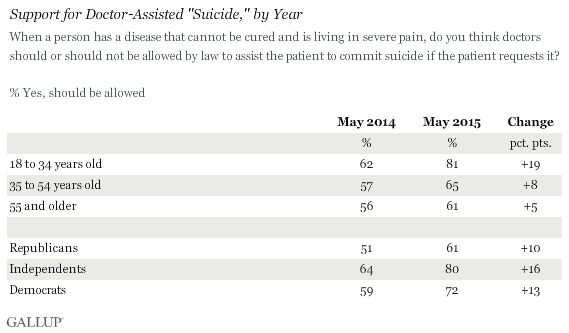
This chart shows the percentage of people who support assisted suicide when a person has a disease that cannot be cured and is suffering a greta deal. It provides the percentage of people who support this, the percentage of what political party approves, and how approval rates changed from May 2014-May 2015. The chart has clear labels and is easy to understand. The only problem I could see with this chart is that it could be biased based on the question it is centered around and where the data came from. 

There are many graphs out there that are misleading and do not provide accurate information. You have to be diligent in making sure it comes from a reputable source and that the information shown is accurate. It can definitely be frustrating in locating the graph that actually has good information on it. There are graphs out there with good data, you just have to know where to look and what to look for in determining the accuracy of them. 

Monday, January 29, 2018

Science and I

Science and I have had a pretty good relationship over the years. I've always enjoyed my science classes that I took in high school and middle school. I loved learning about what all science had to offer and the many different subjects you could learn about within science.I wouldn't say my family has never talked about science before, because that would be a lie, but we don't talk about it at every family get together or over family dinner. My mom always asked us what we learned at school that day and my brother and I would always excitedly tell her all the cool things we talked about. Science isn't my favorite subject, but I do find it interesting and want to learn more about it. On a side note, If this sounds extremely wacky and doesn't make any sense, I'm sorry. I have the flu as I'm writing this so bare with me. But hey that could tie into science too, right? Medicine is science and scientists research different medicines to cure sickness, or try to at least. So, yeah, that's cool. Hopefully in the future my posts will be better than this one.